1.6 - Study Method and Error Log
Methodological review date: August 5, 2026
Regulatory-use note: This file provides a study and tracking system. Any regulatory number, date, exception, or provider rule entered into a diagnostic record or error log must be verified against a current authoritative source.
Course role: Converts reading, teaching-material development, practice questions, and mock examinations into a repeatable system for earning EPA Section 608 Universal certification
Learning Objectives
After completing this section, a student should be able to:
- Apply the six-stage study cycle: learn, explain, compare, practice, analyze, and revise.
- Administer and interpret a section-by-section diagnostic test.
- Classify missed, guessed, and uncertain questions using a consistent error system.
- Create effective flashcards and schedule spaced review.
- Use an error log and weekly tracker to determine readiness in Core, Type I, Type II, and Type III.
- Use teaching-material development as an active examination-preparation method.
Introduction
Passing the EPA Section 608 examination requires more than reading a study guide repeatedly. A student must be able to retrieve facts without notes, distinguish similar rules, classify appliances correctly, select the proper procedure, and recognize conditions that change the correct answer.
A strong study system therefore does four things:
- Measures present knowledge.
- Identifies the reason for each error.
- Schedules targeted correction and review.
- Confirms readiness separately in Core, Type I, Type II, and Type III.
This section provides that system. It is designed for both independent study and classroom use and supports the development of the complete teaching-material project.
Key Concepts
1. The Six-Stage Study Cycle
Use the following cycle for every major topic:
Learn → Explain → Compare → Practice → Analyze → Revise
The cycle should be repeated until the student can explain and apply the concept without relying on notes.
Stage 1 — Learn
Read the instructional section and identify:
- Important definitions.
- Equipment classifications.
- Regulatory requirements.
- Numerical thresholds.
- Conditions and exceptions.
- Safety procedures.
- Commonly confused terms.
Do not begin by memorizing answer letters from practice questions.
Stage 2 — Explain
Close the source and explain the topic in your own words.
A complete explanation should answer:
- What is it?
- Why does it matter?
- When does it apply?
- What condition changes the answer?
- What similar concept could be confused with it?
A student who can recognize a sentence in a book but cannot explain it without looking has not yet developed reliable recall.
Stage 3 — Compare
Place similar concepts side by side.
Useful comparisons include:
- Type I versus Type II.
- Type II versus Type III.
- Section 608 versus Section 609.
- Recover versus recycle versus reclaim.
- System-dependent versus self-contained recovery equipment.
- Current versus historical requirements.
- Service requirements versus disposal requirements.
- Required practice versus recommended good practice.
Tables are especially useful during this stage.
Stage 4 — Practice
Answer new questions without notes.
Practice should include:
- Direct fact questions.
- Classification questions.
- Procedure-sequence questions.
- Scenario questions.
- Questions containing exceptions.
- Questions using
not,except,minimum,maximum,first, orbest.
Practice should test the concept, not the memory of a previously seen question.
Stage 5 — Analyze
For every missed, guessed, or uncertain question, determine:
- What concept was tested?
- What answer was selected?
- Why was that answer attractive?
- What condition made it incorrect?
- Why is the correct answer better?
- Was the source current?
- What should be reviewed next?
A correct guess must still be treated as an unresolved item.
Stage 6 — Revise
Correct the weakness by completing one or more of the following:
- Rewrite the explanation.
- Add or revise a comparison table.
- Create a flashcard.
- Add a note to the quick-reference file.
- Write a new practice question.
- Explain every distractor.
- Recheck the current EPA or eCFR source.
- Schedule the item for spaced review.
Revision is complete only when the student can retrieve and apply the corrected concept later.
2. Diagnostic Testing
A diagnostic test is used to identify present strengths and weaknesses. It is not primarily used to predict a final score.
The project uses two diagnostic levels.
Initial Diagnostic
Recommended structure:
- 10 Core questions.
- 10 Type I questions.
- 10 Type II questions.
- 10 Type III questions.
- 40 questions total.
- Closed-book.
- No answer review until the attempt is complete.
The initial diagnostic provides a quick baseline before intensive study.
Full Diagnostic
Recommended structure:
- 25 Core questions.
- 25 Type I questions.
- 25 Type II questions.
- 25 Type III questions.
- 100 questions total.
- Closed-book.
- Completed within the current time limit of the selected testing provider.
The full diagnostic is used after the student has completed an initial study pass.
Project standard: The diagnostic structure is an instructional choice. The selected EPA-approved testing provider’s current examination rules control the official test.
3. Score Each Section Separately
Calculate each section score independently.
A high combined score must not hide a weak section.
For example, a student may perform well in Core, Type I, and Type II but remain unprepared for Type III. Universal certification preparation requires independent readiness in all four sections.
4. Record Confidence as Well as Correctness
After answering each question, use a confidence code:
| Code | Meaning | Required Action |
|---|---|---|
C3 | Certain and can explain the reason | Confirm during normal review |
C2 | Probably correct but not fully certain | Review the concept |
C1 | Guess between two or more choices | Enter in the error log |
C0 | No reliable basis for the answer | Enter as a high-priority knowledge gap |
A correct C1 or C0 answer is not considered mastered.
5. Error Categories
Each unresolved question should be assigned one primary error category.
| Error Code | Category | Typical Cause |
|---|---|---|
DEF | Definition or terminology | Similar terms were confused |
CLS | Appliance or certification classification | Equipment type or pressure category was misidentified |
REG | Regulatory rule, date, threshold, or exception | A current requirement was not known |
LEG | Legacy or outdated-source error | An old study-guide rule was applied |
PRO | Procedure or sequence | The correct service step or order was not known |
SAF | Safety, cylinder, or equipment-use error | A hazard or safe practice was misunderstood |
CAL | Calculation, units, or table-reading error | Arithmetic, units, or reference data were misused |
READ | Question-reading error | Not, except, or another controlling word was missed |
DIST | Distractor-selection error | A true statement was selected even though it did not answer the question |
REC | Recall failure | The concept had been studied but could not be retrieved |
SRC | Source-verification problem | The answer source was incomplete, secondary, or unverified |
GUE | Correct guess or low-confidence answer | The answer was correct without reliable reasoning |
Use only one primary code for tracking. Add a secondary note when more than one issue contributed.
6. Error Priority
Not every error has equal importance.
| Priority | Meaning | Examples | Review Timing |
|---|---|---|---|
P1 | Immediate correction required | Safety rule, current regulation, numerical threshold, venting, recovery requirement | Same day |
P2 | Important recurring concept | Certification type, refrigerant classification, recovery sequence | Within 1 day |
P3 | Isolated or lower-frequency issue | Minor terminology or uncommon detail | Within 3 days |
Repeated P2 errors should be raised to P1.
7. Flashcards
Flashcards are useful for information that must be retrieved quickly.
Good flashcard subjects include:
- Definitions.
- Certification categories.
- Equipment examples.
- Numerical thresholds.
- Required evacuation levels.
- Recovery percentages.
- Dates that change requirements.
- Safety rules.
- Refrigerant classifications.
- Similar terms that must be distinguished.
Flashcard Rules
Each card should:
- Test one main concept.
- Include the condition that controls the answer.
- Require recall rather than recognition.
- Use the student’s own wording.
- Include a source-status label when the content is regulatory.
- Be revised when the prompt is ambiguous.
- Avoid memorizing an answer letter.
Example — Classification Card
Front
A field-connected residential split system contains 4 pounds of refrigerant. Is it Type I or Type II, and why?
Back
Type II. A charge of 5 pounds or less is not sufficient for Type I. A small appliance must also be fully manufactured, charged, and hermetically sealed at a factory.
Example — Examination Condition Card
Front
Can an open-book Core result be used to obtain Universal certification?
Back
No. Universal certification requires the applicable examination sections under secure, proctored conditions, and an open-book Core result cannot be used toward Universal certification.
8. Spaced Review
Review a corrected concept repeatedly over increasing intervals.
Recommended project schedule:
| Review | Timing | Required Action |
|---|---|---|
| Review 0 | Same study session | Read the correction and explain it without notes |
| Review 1 | 1 day later | Answer the flashcard or a new question |
| Review 2 | 3 days later | Apply the concept in a scenario |
| Review 3 | 7 days later | Include it in a mixed quiz |
| Review 4 | 14 days later | Include it in a section test |
| Review 5 | 30 days later | Confirm long-term retention when the course schedule permits |
A missed review question restarts the sequence at Review 0.
High-priority regulatory and safety items should remain in the mixed-review pool even after the scheduled sequence is completed.
9. Interleaved Practice
Do not study only one topic repeatedly for an extended period.
After initial learning, mix related topics so that the student must identify which rule applies.
Examples:
- Mix Type I and Type II equipment examples.
- Mix stationary systems, MVACs, and MVAC-like appliances.
- Mix recovery, recycling, and reclamation questions.
- Mix current and historical regulatory statements.
- Mix functional- and nonfunctional-compressor conditions.
- Mix service and disposal scenarios.
Interleaving improves classification and reduces dependence on chapter order.
10. Section-Level Readiness
The project uses a higher readiness target than a minimum passing threshold.
Project readiness target: At least 22 correct answers out of 25 in Core, Type I, Type II, and Type III on two separate closed-book cumulative practice attempts.
This equals 88 percent in each section.
A section is considered ready only when all of the following are true:
- The score target is met twice.
- The attempts use different question sets.
- The student completes the test within the selected provider’s current time limit.
- No unresolved
P1errors remain. - Correct guesses have been reviewed.
- The student can explain the major distinctions without notes.
- Current regulatory items have been verified.
11. Readiness Status Levels
Use the following project status labels.
| Status | Score and Evidence | Required Action |
|---|---|---|
| Critical Review | 0–14 correct out of 25 or major knowledge gaps | Return to instruction before taking another section test |
| Developing | 15–17 correct out of 25 | Review weak topics and complete targeted practice |
| Near Ready | 18–21 correct out of 25 | Correct remaining errors and take a new mixed test |
| Ready | 22–25 correct out of 25 once | Confirm with a second independent attempt |
| Confirmed Ready | 22–25 correct out of 25 twice with no unresolved P1 errors | Proceed to the official examination when all sections meet the standard |
These are project preparation levels, not federal scoring rules.
12. Teaching-Material Development as Examination Preparation
Creating the teaching material is an active learning process when the student does more than copy text.
For each subsection:
- Read the current authoritative source.
- Explain the concept in original wording.
- Build a comparison table when useful.
- Identify likely examination traps.
- Create an original figure or figure specification.
- Write original concept-check questions.
- Explain why every distractor is wrong.
- Mark current, historical, and provider-specific information.
- Add uncertain items to the verification list.
- Revisit the section after practice-test errors.
This process strengthens preparation because it requires:
- Retrieval.
- Organization.
- Comparison.
- Explanation.
- Application.
- Error detection.
- Source evaluation.
A section is not considered complete merely because the Markdown file is long. It is complete when the material is accurate, teachable, testable, and connected to the error log.
Technical and Project Activities
1. Diagnostic Test Procedure
Before the Test
- Select the initial or full diagnostic.
- Use original questions not reviewed immediately beforehand.
- Remove notes and references.
- Prepare a timer based on the selected practice format.
- Prepare the diagnostic score table.
- Record one confidence code for every answer.
During the Test
- Answer every question.
- Mark questions containing uncertainty.
- Do not check references.
- Do not change an answer without identifying a specific reason.
- Record the section and question number clearly.
After the Test
- Score Core, Type I, Type II, and Type III separately.
- Enter every incorrect answer in the error log.
- Enter every
C0orC1answer, even if correct. - Assign an error code and priority.
- Identify the source file to review.
- Schedule the next review.
- Update the weekly readiness tracker.
2. Diagnostic Score Table
Copy and complete the following table after each diagnostic.
| Section | Correct | Attempted | Score | C0–C1 Answers | Open P1 Errors | Status |
|---|---|---|---|---|---|---|
| Core | ||||||
| Type I | ||||||
| Type II | ||||||
| Type III | ||||||
| Total |
Diagnostic Summary
- Date:
- Question set:
- Testing condition: Open-book / Closed-book
- Time allowed:
- Time used:
- Strongest section:
- Weakest section:
- Highest-priority topic:
- Next study action:
3. Personal Error-Log Template
Use one entry for every missed, guessed, or uncertain question.
### Error Entry

- **Date:**
- **Question source and number:**
- **Examination section:** Core / Type I / Type II / Type III
- **Topic:**
- **Confidence code:** C0 / C1 / C2 / C3
- **Selected answer:**
- **Correct answer:**
- **Primary error code:** DEF / CLS / REG / LEG / PRO / SAF / CAL / READ / DIST / REC / SRC / GUE
- **Priority:** P1 / P2 / P3
- **Why my answer seemed reasonable:**
- **What condition or fact I missed:**
- **Correct explanation in my own words:**
- **Why each competing option is incorrect:**
- **Instructional file to review:**
- **Authoritative source or project reference:**
- **Source status:** CURRENT EPA REQUIREMENT / TECHNICAL FOUNDATION / LEGACY / PROVIDER-SPECIFIC / REQUIRES VERIFICATION
- **Correction completed:**
- **Flashcard created or revised:** Yes / No
- **Next review date:**
- **Review 1 result:**
- **Review 2 result:**
- **Closed date:**
4. Error-Log Summary Table
The detailed entries may be stored below the table or in a separate working file.
| Error ID | Section | Topic | Code | Priority | Next Review | Status |
|---|---|---|---|---|---|---|
| E-001 | Open | |||||
| E-002 | Open | |||||
| E-003 | Open |
Recommended status labels:
OpenCorrectedReviewingClosedReopened
5. Weekly Readiness Tracker
Complete one tracker each week.
Week Information
- Week beginning:
- Primary goal:
- Planned study hours:
- Actual study hours:
- Official-exam target date, if scheduled:
Daily Study Record
| Day | Section | Instruction or Review Completed | Practice Questions | Score | Next Action |
|---|---|---|---|---|---|
| Monday | |||||
| Tuesday | |||||
| Wednesday | |||||
| Thursday | |||||
| Friday | |||||
| Saturday | |||||
| Sunday |
Weekly Section Status
| Section | Baseline Score | Latest Score | Open Errors | Open P1 Errors | Readiness Status |
|---|---|---|---|---|---|
| Core | |||||
| Type I | |||||
| Type II | |||||
| Type III |
Weekly Reflection
- Most improved topic:
- Most persistent error:
- Regulatory item requiring verification:
- Flashcards due next week:
- Section requiring the most time next week:
- Change to the study plan:
6. Regulatory-Verification Reminder Field
Use this record whenever a statement includes a regulation, numerical requirement, compliance date, exception, or provider procedure.
### Regulatory Verification Record

- **Statement or value being checked:**
- **Topic and section:**
- **Information type:** CURRENT EPA REQUIREMENT / PROVIDER-SPECIFIC / LEGACY / REQUIRES VERIFICATION
- **Primary authority:**
- **Source URL or document location:**
- **Relevant section, table, or paragraph:**
- **Date the source was published or updated:**
- **Date verified:**
- **Verified by:**
- **Current wording to use:**
- **Historical wording found in older material, if applicable:**
- **Next planned verification date:**
- **Status:** Verified / Needs Review / Superseded
- **Notes:**
Regulatory Verification Triggers
A new verification record should be created when:
- Two sources disagree.
- A practice question uses an old penalty value.
- A leak-rate threshold differs from current EPA information.
- An evacuation table differs among study guides.
- A provider changes its time limit or retake policy.
- A source uses language such as
currently,effective,after, orbefore. - An older guide presents a rule without a verification date.
- A regulatory answer cannot be traced to a primary source.
7. Two-Week Intensive Implementation Example
The following schedule is an optional project plan, not an EPA requirement.
| Day | Primary Work |
|---|---|
| 1 | Initial 40-question diagnostic, error-log setup, Module 1 review |
| 2 | Core environmental and regulatory topics |
| 3 | Core refrigerant and refrigeration fundamentals |
| 4 | Core recovery, recycling, reclamation, cylinders, and safety |
| 5 | Core mixed practice and error correction |
| 6 | Core section test and targeted revision |
| 7 | Type I instruction and practice |
| 8 | Type I review and Type II introduction |
| 9 | Type II service, recovery, and evacuation topics |
| 10 | Type II mixed practice and section test |
| 11 | Type III instruction and practice |
| 12 | Type III section test and Universal comparison review |
| 13 | Full 100-question mock examination and error correction |
| 14 | Second cumulative assessment or official examination if every readiness condition is met |
The schedule should be extended when any section remains below the project target.
Important Terms
Active Recall
Active recall is the deliberate retrieval of information without looking at the answer or source.
Confidence Code
A confidence code records how certain the student was and whether the answer was supported by reliable reasoning.
Diagnostic Test
A diagnostic test is an assessment used to identify strengths, weaknesses, and study priorities.
Error Log
An error log is a structured record of missed, guessed, or uncertain questions and the actions taken to correct them.
Interleaved Practice
Interleaved practice mixes related topics so that the student must determine which concept or rule applies.
Retrieval Practice
Retrieval practice requires the student to recall and apply knowledge rather than reread it passively.
Spaced Review
Spaced review revisits information over increasing time intervals to strengthen retention.
Teach-Back
Teach-back is the process of explaining a concept clearly enough that another student could learn it.
Figures and Diagrams
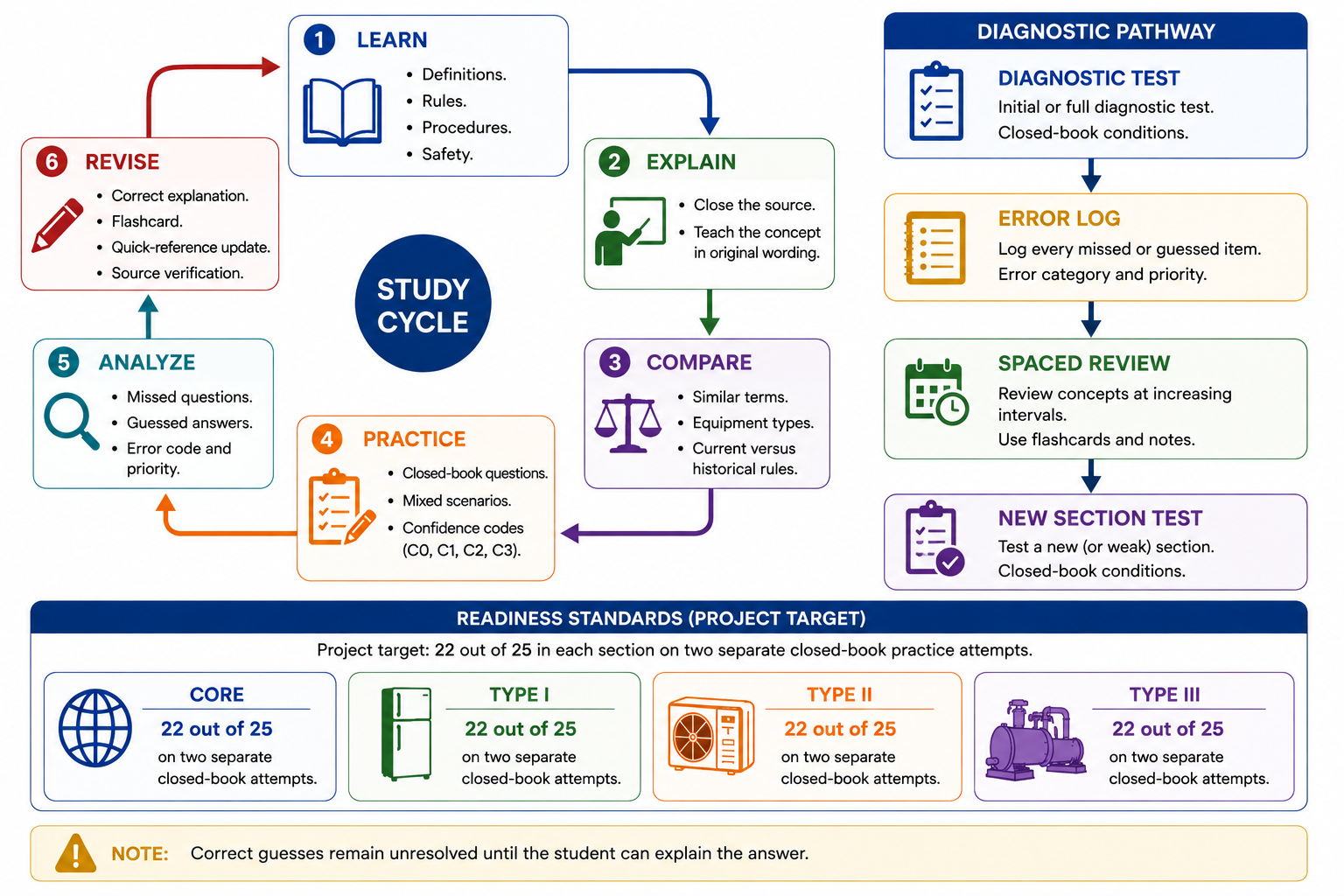
Figure 1.6.1 – Study, error-correction, and readiness cycle for EPA Section 608 Universal certification preparation.
AI-generated instructional figure: It may contain visual inaccuracies. Use the accompanying lesson text and cited authoritative sources to verify technical and regulatory details.
EPA 608 Exam Focus
The study method itself is not normally a direct Section 608 test topic. Its purpose is to improve performance on the actual test topics.
High-Priority Preparation Rules
- Track Core, Type I, Type II, and Type III separately.
- Review correct guesses as well as incorrect answers.
- Use current sources for regulatory items.
- Treat outdated-source errors as a separate category.
- Practice without notes before claiming readiness.
- Use new questions rather than memorized questions.
- Explain why incorrect options are wrong.
- Review numerical thresholds together with their conditions.
- Mix similar appliance and procedure scenarios.
- Do not schedule the official Universal test until every section meets the readiness standard.
Typical Weakness Patterns
| Weakness Pattern | Likely Cause | Corrective Action |
|---|---|---|
| High Core score, low Type III score | Familiarity with residential HVAC but limited low-pressure experience | Add Type III diagrams, procedure tables, and targeted practice |
| Good direct-fact score, poor scenario score | Recognition without application | Use interleaved scenario questions |
| Repeated numerical errors | Thresholds memorized without conditions | Build condition-based flashcards and comparison tables |
| Correct answers with low confidence | Partial recall or successful guessing | Add to error log and retest |
| Errors from old study guides | Legacy information not identified | Verify against current EPA or eCFR source |
| Strong untimed score, poor timed score | Slow retrieval or excessive rereading | Use timed mixed sets and improve decision rules |
Repeated not or except errors | Question-reading weakness | Mark controlling words before reading choices |
Common Mistakes and Confusing Points
Mistake 1: Tracking Only the Combined Score
Universal preparation requires readiness in all four sections. A combined total can hide a weak Type.
Mistake 2: Reviewing Only Incorrect Answers
A correct guess is not reliable knowledge and must be reviewed.
Mistake 3: Repeating the Same Practice Test
Repeated exposure can create question memory rather than topic mastery.
Mistake 4: Memorizing Answer Letters
Answer order can change. The student must know why the answer is correct.
Mistake 5: Using Flashcards Without Conditions
A number without its equipment type, date, pressure category, or compressor condition can create incorrect recall.
Mistake 6: Treating All Errors the Same
Safety and current-regulation errors require faster correction than isolated low-priority errors.
Mistake 7: Taking Another Mock Test Before Correcting the Previous One
Testing without remediation measures the same weakness repeatedly.
Mistake 8: Trusting an Old Study Guide Without Verification
Older guides may contain superseded thresholds, penalties, dates, or provider procedures.
Mistake 9: Counting Study Hours Instead of Demonstrated Performance
Time spent is useful for planning, but readiness must be shown through recall, explanation, and section scores.
Mistake 10: Marking an Error Closed Too Early
An item should be closed only after successful delayed review, not immediately after reading the answer.
Concept-Check Questions
Question 1
What is the correct order of the project study cycle?
A. Practice, memorize, copy, test, score, repeat
B. Learn, explain, compare, practice, analyze, revise
C. Read, highlight, reread, guess, submit, forget
D. Test, review only correct answers, and retest immediately
Question 2
A student answers a question correctly but records confidence code C1. What should the student do?
A. Count the topic as mastered because the answer was correct
B. Ignore the item unless it appears again
C. Add the item to the error log because the answer was a guess
D. Change the answer to make the diagnostic score more conservative
Question 3
Why must Core, Type I, Type II, and Type III be scored separately?
A. EPA prohibits calculating a total score
B. A combined score can hide a weak examination section
C. Type I questions are always worth more points
D. Only Type III contributes to Universal certification
Question 4
Which error code best describes selecting an old leak-rate threshold from an outdated study guide?
A. LEG
B. CAL
C. READ
D. GUE
Question 5
Which flashcard prompt is most effective?
A. What is answer C?
B. Memorize the number 5
C. What conditions must all be satisfied for an appliance to qualify as a small appliance?
D. Read the Type I chapter again
Question 6
What should happen after a corrected concept is missed during a delayed review?
A. The review sequence should restart at Review 0
B. The item should be permanently removed from the flashcard set
C. The original incorrect answer should be accepted
D. The question should be excluded from future practice
Question 7
Which condition is part of the project’s Confirmed Ready status?
A. A combined score of 70 percent on one familiar test
B. At least 22 out of 25 in every section on two separate attempts with no unresolved P1 errors
C. Completion of every study-guide page regardless of test performance
D. A Type II score high enough to offset a low Type III score
Question 8
What is the main purpose of interleaved practice?
A. To keep every practice set limited to one chapter
B. To force the student to determine which concept or rule applies
C. To reduce the number of topics studied
D. To replace all section-specific practice
Question 9
When should a regulatory-verification record be created?
A. Only after the official examination
B. When sources disagree or an older guide presents an unverified rule
C. Only for spelling corrections
D. Whenever a flashcard is answered correctly
Question 10
When should an error-log entry be marked closed?
A. Immediately after reading the correct answer
B. After the student completes a delayed review and can explain or apply the concept correctly
C. When the practice question is deleted
D. At the end of every calendar week regardless of performance
Answers and detailed explanations will be provided in
1.9 - Answers and Explanations.md.
Section Summary
Effective EPA Section 608 preparation uses a repeating cycle:
Learn → Explain → Compare → Practice → Analyze → Revise
The student should:
- Begin with a diagnostic test.
- Score Core, Type I, Type II, and Type III separately.
- Record confidence as well as correctness.
- Log every missed, guessed, or uncertain answer.
- Classify the error and assign a priority.
- Correct the concept using explanation, comparison, flashcards, new questions, and source verification.
- Review the item over increasing intervals.
- Use teaching-material development as an active-learning process.
- Confirm readiness with at least 22 out of 25 in each section on two separate closed-book cumulative attempts.
The next file consolidates the major Module 1 facts into a quick-reference format.
References
Current EPA Sources
-
U.S. Environmental Protection Agency, Section 608 Test Topics, accessed August 5, 2026.
-
U.S. Environmental Protection Agency, Section 608 Technician Certification Requirements, accessed August 5, 2026.
-
U.S. Environmental Protection Agency, Certification Programs for Section 608 Technicians, accessed August 5, 2026.